Asuwagawa Cherry Blossom Avenue Complete Guide|Highlights, Access, and How to Enjoy Fukui Prefecture’s Premier Cherry Blossom Destination
The Asuwagawa Cherry Blossom Avenue in Fukui City, Fukui Prefecture, is one of Japan’s most prominent cherry blossom destinations, selected as one of the “Japan’s Top 100 Cherry Blossom Spots.” Approximately 600 cherry trees line the levee along the Asuwagawa River running through the heart of Fukui City, extending for 2.2 kilometers in a magnificent display that attracts countless flower-viewing visitors every year.
This article provides comprehensive information to help you fully enjoy this famous cherry blossom destination, including the history and highlights of Asuwagawa Cherry Blossom Avenue, the optimal visiting period, access methods, nearby tourist attractions, and gourmet information.
What is Asuwagawa Cherry Blossom Avenue?
A Cherry Blossom Symbol Celebrated by Fukui Citizens
Asuwagawa Cherry Blossom Avenue is a cherry tree-lined pathway on the levee of the Asuwagawa River, which runs through the center of Fukui City. Spanning approximately 2.2 kilometers from the Kida Bridge to the Shinmeisato Bridge, approximately 600 cherry trees, primarily Somei Yoshino varieties, are planted. During peak bloom, a magnificent pink tunnel appears.
This cherry blossom avenue is more than just a tourist attraction; it holds special significance for Fukui citizens. In spring, families, couples, and friends gather to enjoy flower viewing beneath the cherry blossoms. Brimming with water and greenery, it serves as a walking course beloved by citizens throughout the year.
Why It Was Selected as One of Japan’s Top 100 Cherry Blossom Spots
Asuwagawa Cherry Blossom Avenue was selected as one of the “Japan’s Top 100 Cherry Blossom Spots” in Heisei 2 (1990). This selection was made by the Public Interest Incorporated Foundation Japan Sakura Association, which identifies excellent cherry blossom destinations throughout the country.
The selection was based on its overwhelming scale and beauty. The cherry blossom avenue extending 2.2 kilometers is said to be Japan’s largest in scale. Particularly around Kagetsu Bridge, large Somei Yoshino trees line both sides of the levee, forming the most beautiful cherry blossom tunnel.
History as a Symbol of Disaster Recovery
The history of Asuwagawa Cherry Blossom Avenue dates back to Showa 27 (1952). In that year, coinciding with the Fukui Reconstruction Exposition, cherry trees were planted using funds collected from citizens as a symbol of disaster recovery.
Fukui City suffered catastrophic damage from the 1948 Fukui Earthquake in Showa 23. As a symbol of subsequent reconstruction, cherry trees planted by citizens’ hands have, over more than 70 years, created a landscape representative of Fukui City today. Understanding this historical background allows you to appreciate not only the beauty of the cherry blossom avenue but also the citizens’ wishes for recovery.
Highlights of Asuwagawa Cherry Blossom Avenue
Spectacular Cherry Blossom Tunnel
The greatest attraction of Asuwagawa Cherry Blossom Avenue is undoubtedly the cherry blossom tunnel that appears during peak bloom. Walking on the levee, cherry branches drape from both sides, with the entire overhead expanse turning pink.
Particularly around Kagetsu Bridge, recognized as the most beautiful spot in the cherry blossom avenue, large Somei Yoshino trees planted on both sides of the levee extend their branches in arch-like formations, gently enveloping visitors. On clear days, the contrast between blue sky and pink creates a spectacular view.
Walking under the cherry blossom tunnel is a truly extraordinary experience. When the wind blows, cherry blossoms flutter, creating a magical atmosphere. The 2.2-kilometer distance allows for leisurely strolling and enjoying the varying expressions of the cherry blossoms by location.
Fukui Cherry Blossom Festival and Illumination
The “Fukui Cherry Blossom Festival” is held annually from late March to early April. During this event period, Asuwagawa Cherry Blossom Avenue becomes enveloped in an even more vibrant atmosphere.
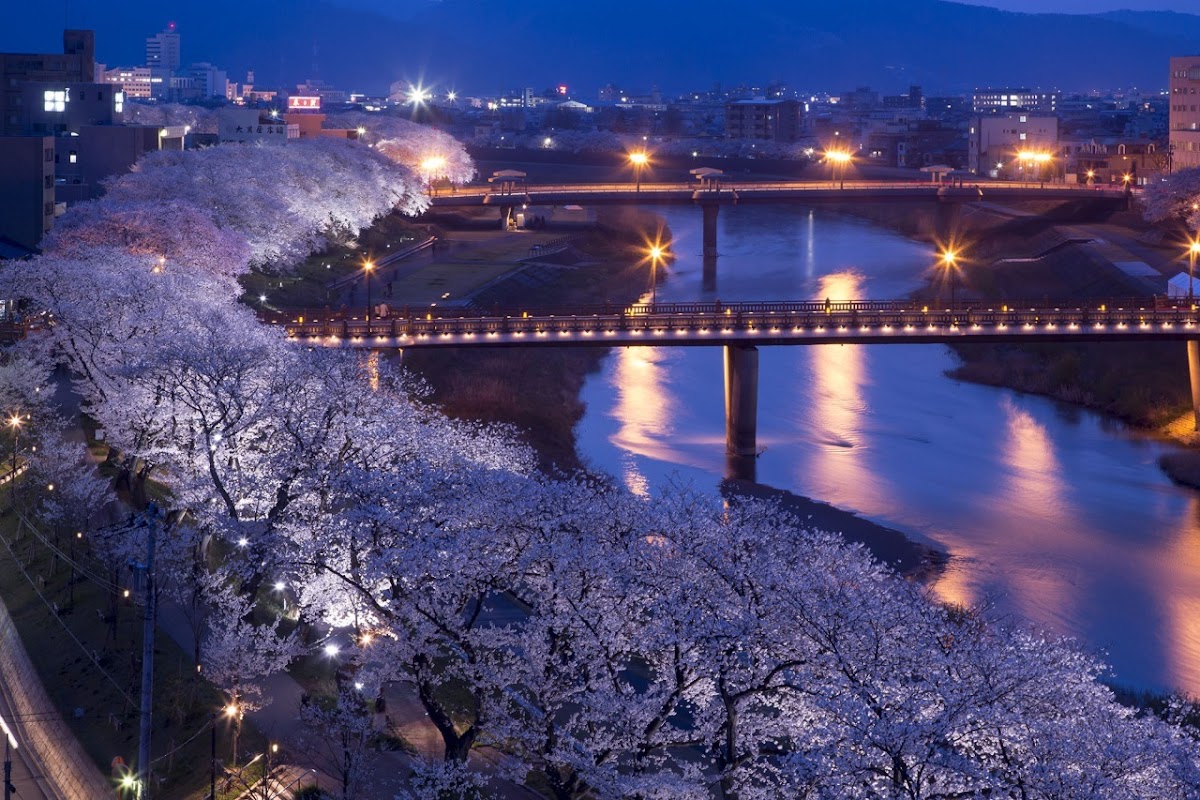
One highlight of the festival is the nighttime illumination. Approximately 1.5 kilometers of the cherry blossom avenue is illuminated, creating a completely different dreamlike landscape from daytime. Lit by lamps, the cherry blossoms reveal a different expression than their daytime pink appearance, presenting a more enchanting and beautiful sight.
Walking beneath the illuminated cherry blossoms creates a sensation of being inside a tunnel of light. The cherry blossoms reflected on the Asuwagawa River’s water surface are also beautiful and popular as photography spots.
Food stalls, food trucks, and cherry blossom beds appear in the riverbed, allowing visitors to enjoy local cuisine and light refreshments while flower viewing. The sight of many people, from families to groups of young people, celebrating the arrival of spring fills the area.
Views from the Riverbed
While viewing cherry blossoms from the levee is wonderful, the view from the Asuwagawa River’s riverbed is equally exceptional. The spacious riverbed allows visitors to enjoy flower viewing picnic-style by spreading out sheets.
From the riverbed, the cherry blossom avenue on the levee is viewed from below, allowing observation of how the cherry trees extend toward the sky. Against a blue sky backdrop, the appearance of the cherry trees offers a different beauty from the view from the levee.
The spacious riverbed typically allows relatively relaxed space allocation even during crowded times, making it ideal for family and group flower viewing. There is space for children to play, allowing for a leisurely time.
Appeal as a Walking Course
Asuwagawa Cherry Blossom Avenue is appreciated as a walking course by citizens throughout the year, not just during cherry blossom season. The levee is paved and well-maintained for easy walking.
The 2.2-kilometer distance is ideal for walking and jogging. Many local residents use it as a morning walking course, making it part of a healthy lifestyle.
Beyond cherry blossom season, fresh green foliage is beautiful during the new growth season, and autumn brings charm through colored autumn leaves on the cherry trees. The ability to enjoy changing seasonal appearances is another attraction of Asuwagawa Cherry Blossom Avenue.
Cherry Blossom Viewing Season and Bloom Information
Typical Bloom and Peak Bloom Times
The cherry blossoms at Asuwagawa Cherry Blossom Avenue typically reach peak viewing conditions from late March to early April. Depending on Fukui Prefecture’s climate conditions, the bloom time varies slightly year to year, but generally follows the following schedule:
- Bloom period: Late March (around March 25)
- Peak bloom period: Early April (around April 2-5)
- Peak viewing period: Approximately 7-10 days from bloom
Somei Yoshino takes about a week from bloom to peak bloom, with beautiful conditions continuing for several days after peak bloom. Depending on weather, the peak viewing period is approximately 7-10 days.
Methods to Obtain Latest Bloom Information
Since cherry blossom bloom is greatly influenced by temperature, it is important to check the latest bloom information when planning a visit. Information can be obtained through the following methods:
Fukui City Tourism Association/Fukui City Tourism Promotion Division: Official websites and social media are regularly updated with bloom status. Local sources provide detailed information.
Weather Information Sites: Sites such as Weather News and Japan Meteorological Agency (tenki.jp) provide real-time cherry blossom bloom forecasts and status updates.
Tourism Information Sites: The “Fukuiro” (Fukui City official tourism site) and “Fukui.com” (Fukui Prefecture tourism site) provide cherry blossom bloom status and peak viewing information.
Beginning to check bloom information one week before your visit allows you to time your visit optimally without missing peak bloom.
Changes in Peak Bloom Due to Weather
Peak bloom changes significantly with weather conditions. If warm days continue, bloom arrives early; if cold days persist, it is delayed. Weather after peak bloom is also important.
Windy days: Strong winds after peak bloom create beautiful cherry blossom snow, but may cause flowers to fall early.
Rainy days: Rain-soaked cherry blossoms have their own charm, but heavy rain causes flowers to fall prematurely. However, cherry blossoms immediately after rain with water droplets are beautiful and an ideal photography timing.
Sunny days: The most beautiful view of cherry blossoms appears on sunny days with blue sky and pink contrast. Particularly, cherry blossoms under soft morning light are exceptional.
Basic Information
Location and Access
Address: 1-chome Tsukumo, Fukui City, Fukui Prefecture (around Kagetsu Bridge)
Cherry blossom avenue extent: Between Kida Bridge and Shinmeisato Bridge (total length approximately 2.2 km)
Access by Public Transportation
From JR Fukui Station:
- Approximately 15-20 minutes on foot
- By bus: Board Kyofuku Bus from Fukui Station, get off at “Kagetsu Bridge” or “Tsukumo” bus stop, walk immediately
When accessing on foot from Fukui Station, head west along the main avenue from the station, proceeding toward the Asuwagawa River. The distance from the station is approximately 1.5 kilometers, with Fukui Castle ruins and shopping streets along the way, allowing you to enjoy city walking while heading to the avenue.
Automobile Access and Parking
Automobile Access:
- Approximately 15 minutes from “Fukui IC” on the Hokuriku Expressway
- Approximately 20 minutes from Fukui Kita IC
Parking Information:
There is no dedicated parking lot around the cherry blossom avenue, but temporary parking may be established during the Fukui Cherry Blossom Festival period. The following parking areas are available:
- Fukui City Hall Parking Lot: May be open to the public on holidays (confirmation required)
- Asuwayama Park Parking Lot: Accessible on foot from Asuwayama Park parking
- Surrounding Coin Parking: Multiple coin parking lots are available around the cherry blossom avenue
During peak cherry blossom season, especially on weekends, parking lots become congested, making public transportation use recommended. Early morning and weekday visits see relatively less crowding.
Business Hours and Admission
Viewing hours: 24 hours free access (evening enjoyment possible during illumination period)
Admission fee: Free
Illumination hours: During Fukui Cherry Blossom Festival, sunset to approximately 22:00 (subject to annual change)
Contact Information
Fukui City Tourism Promotion Division: 0776-20-5346
Fukui City Tourism Association: 0776-20-5151
For the latest event information and bloom status, contact the above.
How to Enjoy the Fukui Cherry Blossom Festival
Event Overview
The Fukui Cherry Blossom Festival is Fukui City’s largest spring event, held annually during the cherry blossom bloom period of Asuwagawa Cherry Blossom Avenue. The 41st festival is scheduled for March 21 (Saturday) through April 5 (Sunday), 2026.
During the event period, the cherry blossom avenue is enveloped in an increasingly vibrant atmosphere, attracting visitors not only from Fukui City but from throughout the prefecture and beyond. Whether enjoying daytime flower viewing or nighttime illumination, it is a spring event representing Fukui.
Food Stalls and Food Trucks
During the cherry blossom festival period, numerous food stalls and food trucks line the Asuwagawa riverbed. From local Fukui cuisine to classic festival food, a variety of dining options are available.
Local cuisine: Restaurants serving Fukui specialties such as sauce katsu-don, Echizen soba, and grilled mackerel sushi also set up shop.
Festival food: Takoyaki, yakisoba, frankfurters, and other classic flower-viewing menu items are abundant.
Food trucks: Increasingly, fashionable food trucks offer crepes, coffee, ethnic cuisine, and diverse selections.
Exploring the food stall area to find your favorite food is one of the pleasures of the cherry blossom festival.
Special Flower Viewing Experience at Cherry Blossom Beds
One of the distinctive festival projects is the “sakura-yuka” (cherry blossom beds). Inspired by Kyoto’s riverbed seating, specially set up seating areas in the riverbed allow more comfortable flower viewing.
Cherry blossom beds feature tables and chairs, allowing visitors to sit comfortably while enjoying cherry blossoms and dining. It offers a refined flower-viewing experience unlike traditional flower viewing with spread sheets.
Illumination Highlights
The nighttime illumination is a highlight of the Fukui Cherry Blossom Festival. The cherry blossom avenue spanning approximately 1.5 kilometers is illuminated, creating a dreamlike landscape.
Illumination characteristics:
- Lighting from beneath cherry trees causes blossoms to appear to float
- The image of cherry blossoms reflected in the Asuwagawa River is beautiful, creating a mirror-like effect
- Cherry blossoms display a completely different appearance from daytime
Photography tips:
- Using a tripod enables beautiful nighttime photography
- Composition including blossoms reflected in water is recommended
- Less-crowded times (weekday evenings or shortly after start) are easier for photography
Nighttime temperatures can drop, so warm clothing is recommended.
Photography Spots for Asuwagawa Cherry Blossom Avenue
Around Kagetsu Bridge
The area around Kagetsu Bridge is known as the most beautiful spot in Asuwagawa Cherry Blossom Avenue. The composition viewing the cherry blossom avenue from the bridge is a classic photography spot.
From the bridge’s center, viewing the cherry blossom avenue on both sides reveals a cherry blossom tunnel extending into the distance. Particularly during peak bloom, a pink band appears to continue to the horizon in a grand landscape.
Cherry Blossom Tunnel from the Levee
Photographing the cherry blossom tunnel from the levee while walking is also recommended. The arch created by overhanging cherry branches on both sides resembles an entrance to another world.
Photography including people is popular, with images of people walking through the cherry blossom tunnel being picturesque. Early mornings and weekdays have fewer people, allowing leisurely photography.
Upward-Gazing Angle from the Riverbed
A composition viewing the cherry blossom avenue on the levee from the riverbed is also beautiful. Cherry blossoms floating against a blue sky background create photos with an open, refreshing impression.
Using a wide-angle lens captures both the expanse of the cherry blossom avenue and the vastness of the sky simultaneously.
Reflected Cherry Blossoms on Water
The image of cherry blossoms reflected in the Asuwagawa River is another photography spot. Particularly on calm, windless days, cherry blossoms reflect like a mirror, creating ethereal photographs.
During illumination, lit cherry blossoms reflected in water display beauty different from daytime.
Nearby Tourist Attractions
Asuwayama Park
Asuwayama Park, accessible on foot from Asuwagawa Cherry Blossom Avenue, is also a premier cherry blossom destination in Fukui Prefecture. The entire Asuwayama is developed as a park with approximately 3,600 cherry trees planted.
Asuwayama Park, located on elevated ground, offers an observation point with panoramic views of Fukui City. A luxurious landscape allowing simultaneous enjoyment of cherry blossoms and Fukui City’s cityscape unfolds.
Visiting both Asuwagawa Cherry Blossom Avenue and Asuwayama Park provides a more enriching cherry blossom tour. If visiting both, plan for half to a full day.
Fukui Castle Ruins
The Fukui Castle Ruins, located along the path from JR Fukui Station to Asuwagawa Cherry Blossom Avenue, is a spot where you can feel Fukui’s history. Currently housing the Fukui Prefectural Government Office and Fukui Prefectural Police Headquarters, the stone walls and moats remain, allowing visitors to sense former grandeur.
In spring, cherry blossoms also bloom near the castle moat, allowing enjoyment of castle ruins and cherry blossom collaboration. A precious spot where experiencing Fukui’s history while cherry blossom viewing is possible.
Yohoji Garden
Adjacent to Fukui Castle Ruins, Yohoji Garden is a beautiful Japanese garden designated as a National Place of Scenic Beauty. Constructed as a villa of the Matsudaira clan, lords of Fukui, the garden features an elegant pond-viewing circuit garden.
In spring, cherry blossoms within the garden are beautiful, allowing appreciation of the harmony between Japanese garden and cherry blossoms. Unlike Asuwagawa Cherry Blossom Avenue, you can appreciate cherry blossoms in a quiet, serene atmosphere.
Ichijodani Asakura Clan Ruins
Approximately 20 minutes by car from Fukui City center, the Ichijodani Asakura Clan Ruins are the remains of a Sengoku period castle town, designated as a National Special Historic Site. In spring, cherry blossoms nearby are beautiful, allowing simultaneous enjoyment of historical romance and cherry blossoms.
Walking through restored samurai residences and town layouts offers a time-slip experience to the Sengoku period. Popular as a combined tour with Asuwagawa Cherry Blossom Avenue.
Eiheiji Temple
Eiheiji Temple, a major tourist attraction in Fukui Prefecture and the head temple of the Soto Zen sect, is approximately 30 minutes by car from Fukui City center.
Visitors can experience zen meditation in a solemn atmosphere and stroll through the beautiful grounds. In spring, cherry blossoms within the temple grounds are beautiful, allowing simultaneous appreciation of Zen philosophy and cherry blossom beauty.
Gourmet Information from the Surrounding Area
Fukui Specialty: Echizen Soba
A must-taste when visiting Fukui is Echizen soba. Multiple soba restaurants are located around Asuwagawa Cherry Blossom Avenue.
Echizen soba is characterized by its dark color from buckwheat ground with whole seeds and unique flavor. The standard preparation method is cold zaru soba with generous amounts of grated daikon radish.
Soba restaurants near the cherry blossom avenue serve authentic Echizen soba beloved by locals. Before or after flower viewing, stop by to experience Fukui’s flavors.
Sauce Katsu-don
Sauce katsu-don, a famous local Fukui dish, is another must-try item. Unlike typical katsu-don, this version features katsu with Worcestershire sauce-based sauce without egg topping.
The harmony between crispy katsu and sauce is excellent, and despite generous portions, it is surprisingly light. It is served at restaurants near Fukui Station and around Asuwagawa.
Grilled Mackerel Sushi
Facing the Sea of Japan, Fukui Prefecture offers abundant fresh seafood. Among these, grilled mackerel sushi is one of Fukui’s representative regional dishes.
Fatly marbled mackerel is grilled and placed atop vinegar rice, with smoky flavor and mackerel umami combining exquisitely. Available for takeout, it is recommended as a flower-viewing bento.
Habutae Mochi
Habutae mochi, a representative Fukui confection, is ideal as a souvenir. Named after the habutae silk textile, it features soft, silky texture and refined sweetness.
Available for purchase at confectioneries near Fukui Station and tourist attractions. Excellent as a sweet dessert after cherry viewing or as a take-home souvenir.
Precautions When Visiting Asuwagawa Cherry Blossom Avenue
Crowd Management
During peak cherry blossom season, especially weekends and holidays, crowds are substantial. The following points help for more comfortable enjoyment:
Early morning visits: 7-9 a.m. sees relatively few people, allowing peaceful cherry blossom appreciation. Cherry blossoms in soft morning light are also beautiful.
Weekday visits: When possible, weekday visits avoid weekend crowds.
Off-peak hours: Since midday experiences maximum crowding, targeting evening or illumination hours is an alternative.
Clothing and Belongings
Clothing: From late March to early April in Fukui, days are warm but mornings and evenings become cold. Particularly for illumination viewing, bringing a layer is recommended.
Comfortable shoes: For the 2.2-kilometer cherry blossom avenue stroll, wear comfortable walking shoes.
Rain gear: Weather changes during this season, making a collapsible umbrella advisable.
Camera: Bring a camera or ensure smartphone battery is charged to document beautiful cherry blossom scenery.
Manners and Rules
Do not break cherry branches: Cherry trees are precious assets. Avoid breaking branches or damaging trees.
Take trash with you: Do not leave trash on the riverbed or levee. When trash receptacles are provided, dispose of waste properly with separation.
Picnic spot courtesy: When reserving riverbed space, avoid claiming unnecessarily large areas.
Noise consideration: Nearby residential areas require avoiding late-night shouting and music.
Smoking: Refrain from smoking outside designated areas.
Cherry Blossom Avenue Preservation Activities
Efforts to Pass to Future Generations
The cherry trees lining Asuwagawa Cherry Blossom Avenue have aged significantly over 70+ years since planting. Fukui City implements various preservation activities to pass this beautiful avenue to future generations.
Cherry tree health examinations: Regular diagnosis by certified arborists monitors cherry tree health.
Treatment and maintenance: Diseased or pest-damaged trees receive ongoing treatment and pruning care.
Young tree planting: New cherry tree planting is planned to systematically replace aging trees.
Citizen-Participated Preservation Activities
Citizen cooperation is essential for Asuwagawa Cherry Blossom Avenue preservation. Fukui City solicits donations from citizens and cherry blossom enthusiasts nationwide through crowdfunding, directing proceeds to preservation efforts.
With the desire to “pass Asuwagawa Cherry Blossom Avenue to future generations 30, 50 years hence,” many participate in preservation activities. Visitors should understand these efforts and approach cherry blossoms with respect.
Summary
Asuwagawa Cherry Blossom Avenue is a premier cherry blossom destination in Fukui Prefecture, selected as one of Japan’s Top 100 Cherry Blossom Spots. The magnificent cherry blossom tunnel created by 600 cherry trees spanning 2.2 kilometers continues to captivate visitors.
As a disaster recovery symbol planted by citizen hands, the cherry blossom avenue, after 70+ years, has become an invaluable asset to Fukui City. Blooming with spring’s arrival, the cherry blossoms warmly welcome citizens and visitors from throughout the prefecture and beyond.
During the Fukui Cherry Blossom Festival, various programs including illumination, food stalls, and cherry blossom beds enhance cherry blossom enjoyment. Diverse enjoyment methods are available: daytime cherry blossom tunnel walks, nighttime dreamlike illumination, and picnic-style riverbed flower viewing.
Excellent access, located within walking distance of JR Fukui Station, is another attraction. Nearby attractions including Asuwayama Park, Fukui Castle Ruins, and Yohoji Garden enable comprehensive Fukui sightseeing combined with cherry blossom viewing.
Enjoy Fukui gourmet including Echizen soba and sauce katsu-don while fully experiencing spring Fukui. To pass this beautiful cherry blossom avenue to future generations, visit with respect for proper manners and care for the cherry trees.
Enjoy a wonderful flower-viewing experience at Asuwagawa Cherry Blossom Avenue in spring 2026.